
How we go from 3,600 applications to 12 founders. The framework
April 2026 · 7 min read | Written by the Decelera team
We get this question often.
"How do you actually pick?"
It comes from founders who've applied. From investors curious about our funnel. From other accelerators trying to compare notes. And from ourselves, every season, when we sit down and look at the spreadsheet and the calendar and the number of conversations we have to fit between January and May.
This post is the answer. It's not a brochure. It's the framework we use, in the order we use it, with the parts we still get wrong.
Discover our program → Apply to Decelera
Table of contents
- The math, before anything else
- Phase 1 — Thesis fit: the hardest filter
- Phase 2 — The first call: who shows up
- Phase 3 — The deep dive: founder due diligence
- Phase 4 — Investment committee: the room test
- Phase 5 — The €300K commitment, before Menorca
- What we're still figuring out
- Frequently asked questions
The math, before anything else
Every year, around 3,600 startups apply to Decelera. From those, 12 founders make it to Menorca.
That's a 0.33% selection rate. Lower than most Ivy League schools. Higher than YCombinator's reported acceptance, but the comparison breaks down quickly because the filter we apply is different.
What's different is what we're filtering for. Most accelerators select for traction, market size, or the polish of the deck. We select for thesis fit, founder readiness, and whether we believe we can build a 10-year relationship with the person sitting across the table.
The funnel narrows in five phases. None of them is automated. None of them is delegated. Every founder who reaches Menorca has had at least three direct conversations with our team before stepping on the island.
Phase 1 — Thesis fit: the hardest filter
The application closes 70% of candidates within the first 48 hours of review.
Not because of quality. Because of fit.
Our investment thesis is specific:
- Mission-driven tech companies addressing real planetary or societal challenges
- Founded from 2022 onward
- Raising up to €3M in their current round
- Valued under €10M pre-money
- Registered in Europe (Southern Europe preferred but not required)
If a startup is a Series B SaaS company in the US, it's a no. Not because they aren't good — because they aren't ours. Thesis fit is the cheapest filter to apply and the most honest one. It saves the founder time and saves us the wrong meeting.
This is also the phase where we read the deck. Not the way investors are taught to read decks. We look for clarity of thinking, not polish of design. Three slides explaining why this problem is worth ten years of someone's life will beat thirty slides of perfectly-formatted growth charts every time.
About 1,080 startups make it past this phase. Roughly 30% of total applications.
Phase 2 — The first call: who shows up
Carlota Lechere, our Dealflow Manager, takes the first call with every shortlisted founder. That's somewhere between 600 and 800 conversations per cohort.
We've thought about delegating this. We won't.
The first call is 30 minutes. It's not a pitch. It's a conversation about why they applied, what they're building, what they need, and what they think Decelera can do for them. The founders who treat it like a pitch tend to lose us in the first ten minutes. The ones who treat it like a real conversation tend to keep us for an hour.
What we're listening for:
- Does the founder understand their own problem deeply?
- Are they coachable, or just confident?
- Have they thought about what they actually need from us, beyond the check?
- Does their energy match the seven-day intensity of Menorca?
After this phase, around 200 founders move forward. The rest receive an honest no, with the reason. We've learned that founders remember a clear no longer than they remember a soft yes.
Phase 3 — The deep dive: founder due diligence
This is where the model gets unusual.
Most VCs do company due diligence. We do founder due diligence. We'll still look at the cap table, the metrics, and the contracts — but the harder work happens elsewhere.
We talk to former co-founders. Former employees. Investors who passed. Investors who said yes. We ask about how the founder handles conflict, what they do when something breaks, whether they tell the truth when the truth is inconvenient.
We're not looking for perfect founders. We're looking for honest ones. The single biggest predictor of whether a founder thrives at Decelera is whether they can sit in a room and admit what they don't know. We've turned down founders with stronger metrics in favour of founders with sharper self-awareness, and we'd do it again.
By the end of this phase, we have a final pool of around 40-50 candidates for 12 spots.
Phase 4 — Investment committee: the room test
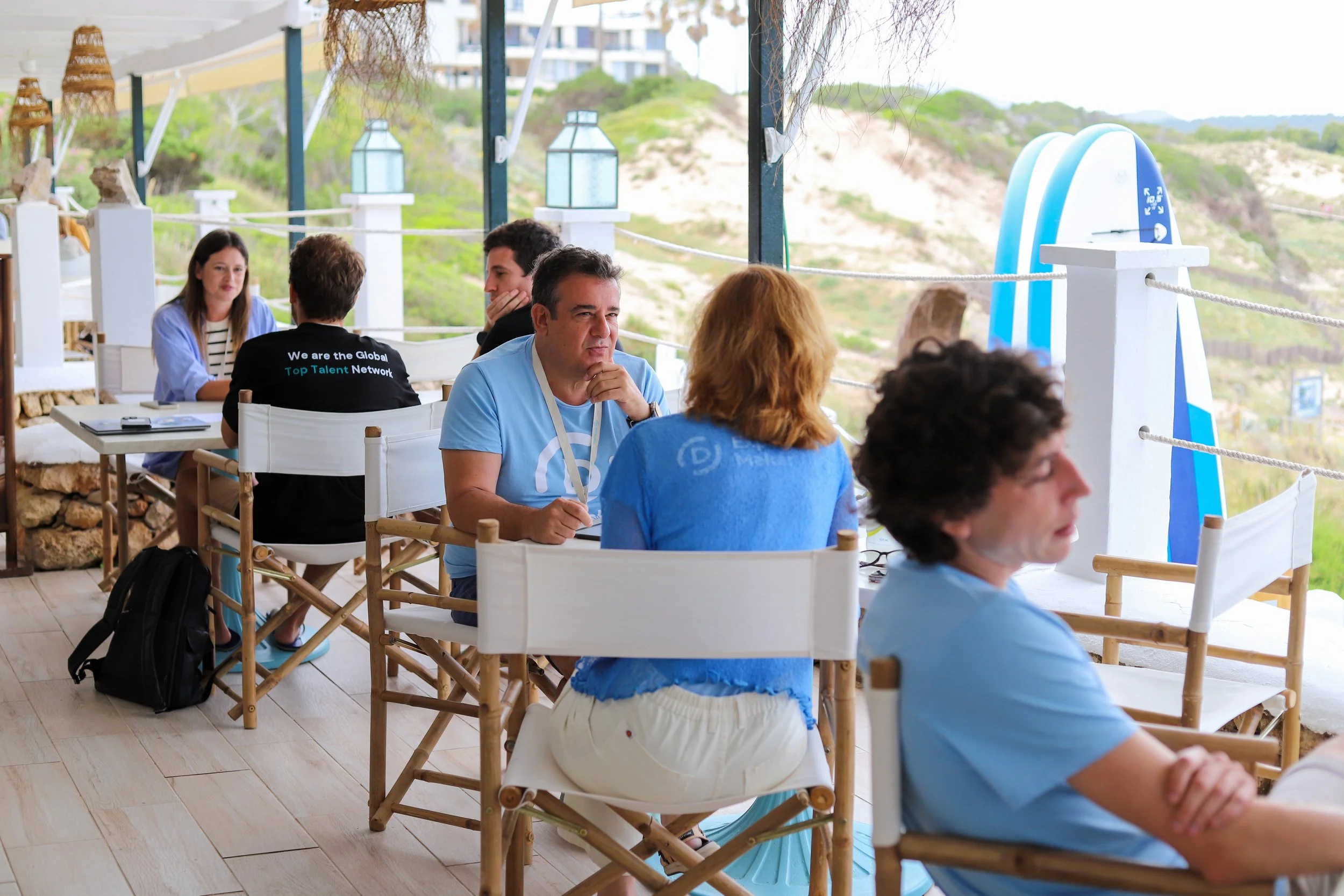
The investment committee meets with Marcos Martín, our CEO, the dealflow team, and rotating partners depending on the sector. We review every finalist together.
The question is not "is this a good company?" The question is "is this a founder we want in the room with the other eleven?"
The cohort is the product. A founder who's brilliant alone but absorbs all the oxygen in a group will hurt the experience for the other eleven. A founder who's quieter but lifts the room will multiply the value of the week for everyone.
We've turned down companies we believed in because the founder profile didn't match the cohort we were building. It's the most subjective phase, and the one we feel most strongly about. The cohort dynamics are not a side effect of selection. They're the point.
This is also the phase where we make the investment decision. Not after the program. Before.
Phase 5 — The €300K commitment, before Menorca
In March 2026, we changed the model.
For years, founders attended Decelera without guaranteed funding. Less than half ultimately received investment. That structure made sense at first — we were learning, and the program gave us a way to evaluate before committing.
But it created a quiet problem. Founders couldn't fully show up if they were also performing for an investment decision. The vulnerability the program asks for and the audition the funding required were pulling in opposite directions.
So we changed it. Now, every founder selected receives €300K before the program begins. One month after Menorca, the strongest performers may receive an additional €700K. Total possible initial investment: €1M per company within weeks.
The change is mechanical. The shift it produced is not. When the check is signed before the program starts, the program becomes what it always wanted to be. A space for honest work, not a seven-day audition.
What we're still figuring out
We don't have the framework perfect.
Three things we're still working on:
- Bias toward founders we can read. Our pattern-matching is shaped by the founders we've already backed. We catch this when we can. We don't always catch it in time.
- The 200 conversations problem. Doing a real call with every shortlisted founder is the right thing for them and the right thing for us, but it's expensive. As applications grow, this is the part of the process that strains first. We haven't found a way to scale it without diluting it.
- Communicating the funnel without scaring people off. A 0.33% acceptance rate looks intimidating in a headline. Most of those 3,600 applications are filtered out for thesis fit, not founder quality. If you're early-stage, in Europe, raising under €3M, the real selection rate for your category is closer to 1.5%. We're working on how to say that without it sounding like a sales pitch.
We're writing this down because the founders who apply deserve to know how the decision gets made. Not the version that sounds best, the version that's actually true.
Frequently asked questions
How long does the full process take?
Between four and ten weeks, depending on when in the cycle you apply. Founders who apply in January typically have more time for multiple conversations. Founders who apply in late April are reviewed faster, but with less back-and-forth.
Is the process the same for European and Mexican applicants?
The framework is the same. The thesis differs slightly between the two funds. The Mexican fund focuses on the Hispanic ecosystem and uses the Mexico City team for first calls. The decision logic is identical.
Do you reject founders who reapply later?
No. About 15% of each cohort applied to a previous edition and were not selected. Often the fit changes — the company evolves, the founder grows, the cohort dynamic for that year matches better. Reapplying is a signal we take seriously.
What's the most common reason for rejection?
Thesis fit. The vast majority of rejections aren't about founder quality, they're about whether the company matches our investment criteria. The second most common reason is timing — sometimes the company is too early or too far along for the program to add real value.
Why don't you publish the full criteria publicly?
We publish most of them. The thesis is on our How We Invest page. What we don't publish is the qualitative weighting between criteria, because it shifts depending on the cohort we're building. A 50-applicant pool with strong climate-tech might pull us toward more climate founders for that edition. A pool with rich AI infrastructure might shift the balance the other way. Cohort-building is a craft, not a checklist.
Can I apply to the next edition?
Yes. Applications are reviewed on a rolling basis at decelera.ventures/apply. The earlier in the cycle you apply, the more time we have to do the work properly.