
AI and the future of work: key takeaways from the Decelera Gathering in Madrid
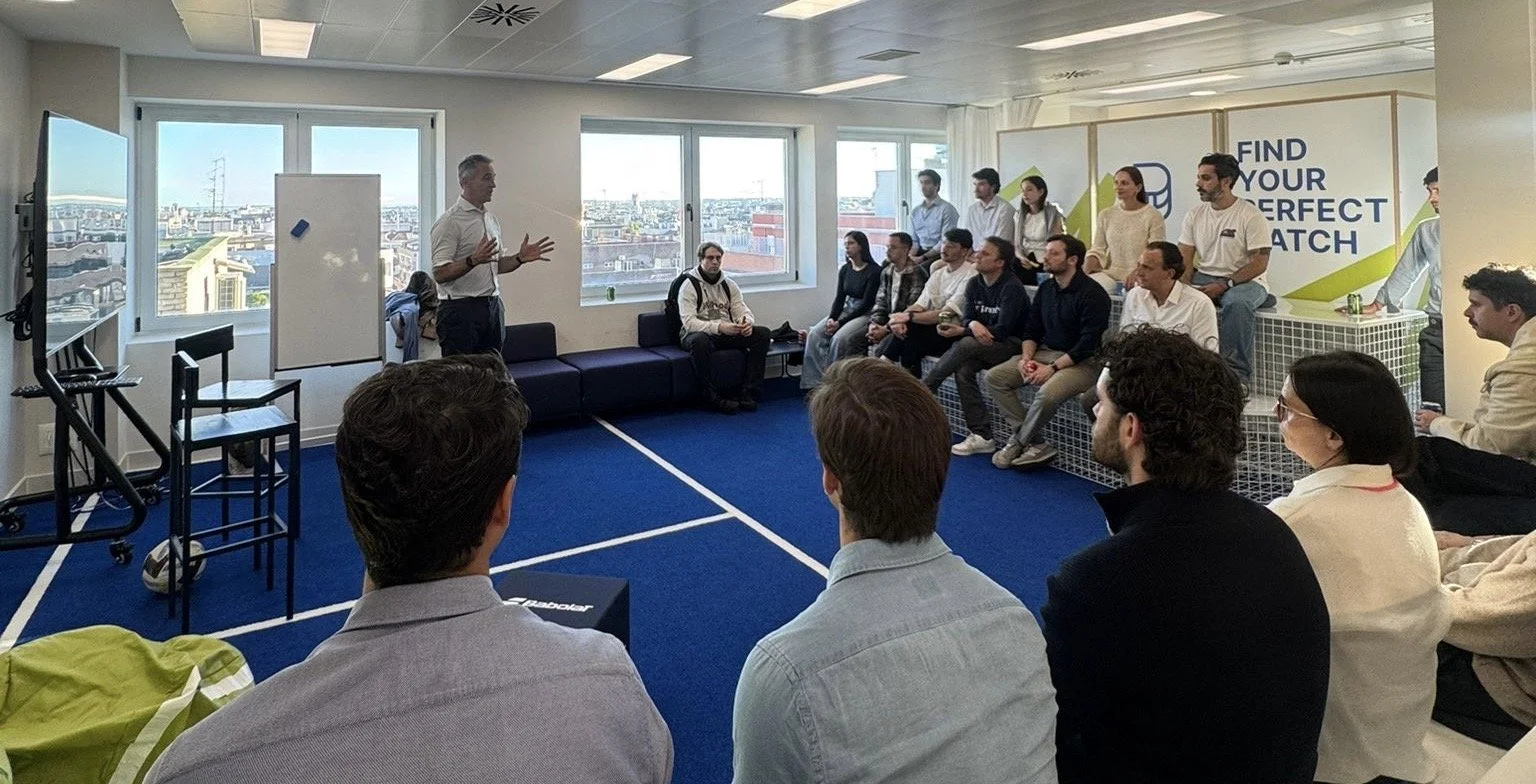
Table of contents
- What happened in Madrid
- On integrating AI into organisations: the hybrid model
- On culture and fear: the real barrier isn't technical
- On product building: speed is not a strategy
- On defensibility: software is no longer a moat
- The one practical framework worth taking home
- How Decelera fits in
- Frequently asked questions
What happened in Madrid
On April 15, the Decelera community gathered in Madrid for an informal evening at the Playtomic offices. The event brought together founders, operators, and people close to the Decelera ecosystem for a conversation about where things stand, how the Decelera model has evolved, and what comes next as Menorca 2026 approaches.
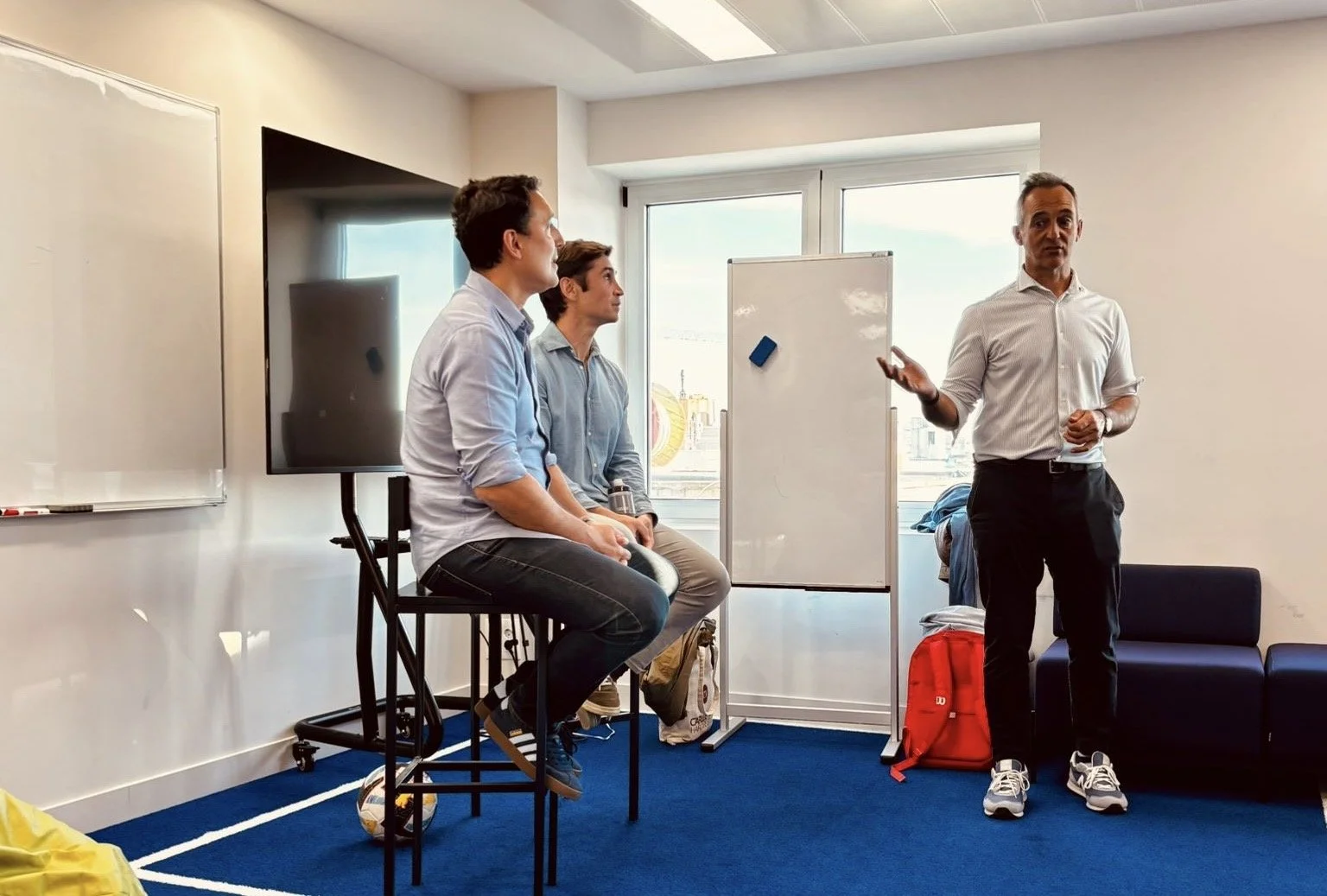
The centerpiece of the evening was a discussion about AI and the future of work, led by Pedro Clavería, Co-founder and Chief Strategy Officer at Playtomic, and Andrés Spitzer, CEO of Civitatis.
Playtomic has grown into one of the largest racket sports platforms in the world, with over $70 million raised and operations spanning multiple continents. Civitatis is one of Europe's leading travel experiences marketplaces, and Spitzer took over as CEO in January 2026 after the founder stepped back following 18 years at the helm. Both bring a perspective shaped by scaling real companies through real complexity, not from the conference stage.
What followed wasn't a keynote or a panel. It was a room full of people who build things for a living, talking honestly about what AI is changing inside their companies right now. These are the main threads that emerged.
On integrating AI into organisations: the hybrid model
The core question the room kept returning to isn't whether to adopt AI. That's no longer a decision. The real question is how to do it without losing what makes a company human.
The challenge is designing hybrid organisations where people focus on what requires creativity, judgment, and human connection, while AI agents handle repetitive, low-value tasks. This isn't a theoretical framework. Multiple founders in the room described workflows where human and agent components already work side by side, and the companies that have figured out the right balance are moving faster than those still debating whether to start.
The distinction matters. Hybrid doesn't mean "humans plus a chatbot." It means rethinking entire workflows from scratch, deciding for each step whether a human needs to be involved and what kind of involvement that should be. Some steps disappear entirely. Others become more important because the human judgment they require stands out more clearly once the noise around them is gone.
What was striking was the consensus: this shift is coming regardless of whether individual companies choose to lead or follow. The organisations that design for it intentionally will outperform those that let it happen to them.
On culture and fear: the real barrier isn't technical
If the technical integration of AI is the visible challenge, the cultural one is the invisible one, and it's bigger.
Many teams still resist AI adoption. The resistance isn't irrational. Fear of job displacement is real, and dismissing it doesn't make it go away. But the framing needs to shift. The question "will AI take my job?" is the wrong question. The right one is: "what does this role look like when I'm freed from the tasks that don't need me?"
That reframing changes the conversation from threat to opportunity, but only if leadership backs it up with real structural changes, not just messaging.
Recruitment is already evolving. Several founders in the room noted that specific job titles matter less than they used to. What matters more is whether a candidate understands workflows end-to-end and knows how to work alongside AI tools. The job description of the future isn't "marketing manager" or "data analyst." It's someone who can design a workflow, decide which parts should be automated, and manage the human-agent handoffs where quality and judgment matter most.
This has implications for every early-stage founder in the room. The teams you build today will either be designed for this reality or will need to be rebuilt when it arrives. Designing for it now is cheaper than retrofitting later.
On product building: speed is not a strategy
AI makes building features faster than ever. That sounds like good news, and in many ways it is. But the room quickly identified the shadow side: the risk of overbuilding.
When the cost of building a feature drops to near zero, the temptation is to build everything. Every idea that surfaces in a meeting can become a prototype by the end of the day. The bottleneck shifts from "can we build it?" to "should we build it?" And that second question requires a different kind of discipline, one that many engineering-led teams aren't used to applying.
The product role becomes more important, not less. When anyone can ship code, the value moves upstream to deciding what's worth building, understanding what actually serves the customer versus what's just technically possible. Engineers can no longer just write code. They need to contribute to shaping the product itself, to have opinions about what should exist and what shouldn't.
For early-stage founders, this is a critical insight. The advantage of being small used to be speed. Now everyone has speed. The advantage of being small is focus, the ability to say no to 90% of what's possible and go deep on the 10% that matters. AI amplifies whatever you point it at. If you point it at the wrong thing, you just build the wrong thing faster.
On defensibility: software is no longer a moat
This was perhaps the most provocative point of the evening, and the one that generated the most debate.
Software alone is no longer a moat. It can be copied in seconds. A feature that took your team six months to build can be replicated by a competitor with AI tools in a fraction of the time. The technical barrier to entry that protected software companies for the last two decades is eroding rapidly.
So where does defensibility live now? The room converged on three things: brand, community, and distribution.
Brand is the trust and recognition you've built over time. It can't be cloned with a prompt. Community is the relationships between your users, the network effects that make your product more valuable the more people use it. Distribution is the channels, partnerships, and positioning that get your product in front of the right people. All three take time and intention to build. None of them can be shortcut with AI.
For founders at the early stage, this means thinking about defensibility differently from day one. If your entire value proposition is a piece of software, you're building on sand. If your software is the vehicle for a brand, a community, or a distribution advantage, you have something AI can't easily replicate.
The one practical framework worth taking home
Across all the threads, one practical takeaway emerged that multiple people in the room said they'd implement immediately.
Map your workflows into a matrix with two axes: tasks that can be fully automated with AI, and tasks that need human review or judgment. Go through every process in your company, from customer support to product development to hiring, and place each step on that matrix.
The exercise sounds simple. It isn't. The hard part is being honest about which tasks genuinely require human involvement and which ones your team holds onto because they're familiar, not because they're irreplaceable.
Getting that matrix right is the real work of AI integration. Not choosing a model. Not picking a vendor. Understanding your own workflows deeply enough to know where the human matters and where the machine is better.
How Decelera fits in
The Decelera Community Gathering in Madrid is part of how we keep our ecosystem connected between programs. The conversations that happen in these rooms, between founders at different stages, operators who've scaled real companies, and investors who've seen hundreds of models, are the kind of conversations that don't happen in webinars or Slack channels.
If you're building a company and thinking seriously about how AI changes the way you build your team, your product, and your competitive position, these are the conversations worth being part of.
Decelera Menorca 2026 is approaching. The program brings together a curated group of early-stage founders for 7 days of exactly this kind of thinking, focused, honest, and designed to change how you make decisions.
Learn more about the program →
Frequently asked questions
What is a Decelera Community Gathering?
A Decelera Community Gathering is an informal event for founders, operators, and people in the Decelera ecosystem. These events happen in different cities between programs and are designed to keep the community connected and the conversation going. The Madrid gathering on April 15, 2026, was hosted at the Playtomic offices.
Who spoke at the Madrid gathering?
The AI and Future of Work discussion was led by Pedro Clavería, Co-founder and Chief Strategy Officer at Playtomic, and Andrés Spitzer, CEO of Civitatis, with a broader group of founders and operators in the room.
What is the "hybrid organisation" model discussed at the event?
A hybrid organisation is one where workflows are designed with both human and AI agent components. Humans focus on tasks requiring creativity, judgment, and connection, while AI agents handle repetitive, low-value tasks. The key is designing these workflows intentionally rather than letting AI adoption happen ad hoc.
Why is software no longer considered a moat?
Because AI tools have dramatically reduced the time and cost of building software features. What took months can now be replicated in days or weeks. Defensibility has shifted to brand, community, and distribution, assets that require time and intention to build and can't be replicated by AI.
How can founders start integrating AI into their companies?
The most practical starting point from the gathering: map every workflow in your company into a matrix of what can be fully automated versus what needs human review. Be honest about which tasks genuinely require human judgment. That matrix becomes your AI integration roadmap.
What is Decelera Menorca 2026?
Decelera Menorca is a 7-day residential program for early-stage founders, combining investment (up to €300K initial ticket, up to €1M follow-on) with a curated experience designed to help founders make better decisions about how they build their companies.